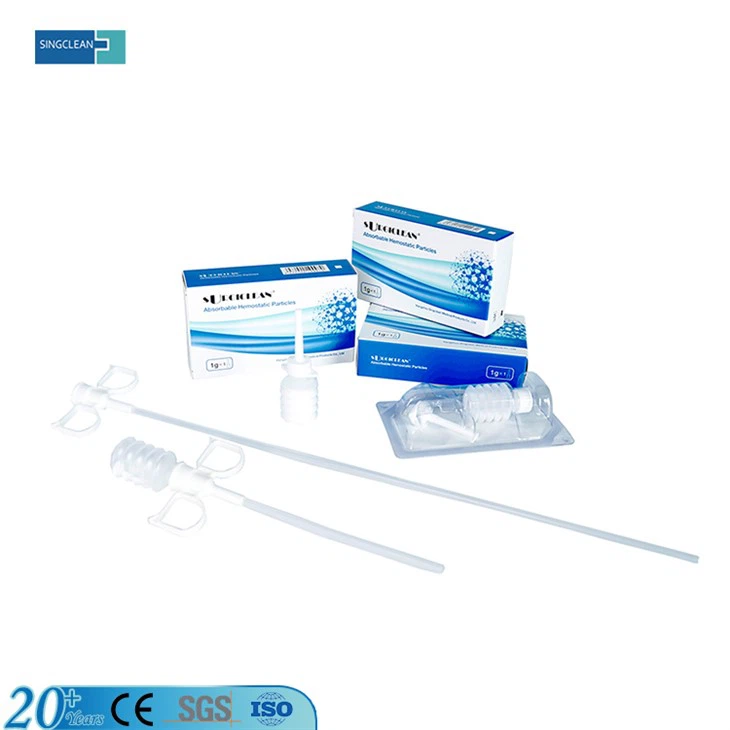
Hey there! As a supplier of hemostasis powder, I often get asked about the main ingredient of this nifty product. So, I thought I'd take a deep - dive into this topic and share all the juicy details with you.
First off, let's understand what hemostasis powder is for. It's a key player in the medical field, used to stop bleeding quickly. Whether it's in a surgical setting, for first - aid in emergencies, or even in veterinary medicine, hemostasis powder can be a real lifesaver.
Now, the main ingredient of most hemostasis powders out there is usually a type of polysaccharide. Polysaccharides are long chains of sugar molecules, and they have some pretty amazing properties when it comes to stopping bleeding.
One of the commonly used polysaccharides is chitosan. Chitosan is derived from chitin, which is found in the exoskeletons of crustaceans like crabs and shrimps. It's a natural polymer, and that's a big plus in the medical world. Why? Well, it's biocompatible, which means it can interact well with our body tissues without causing a lot of negative reactions.
When chitosan - based hemostasis powder comes into contact with blood, it starts to work its magic. It has a positive charge, and red blood cells have a negative charge. This difference in charge causes the red blood cells to clump together around the chitosan particles. As more and more red blood cells clump, a clot starts to form. This clot then acts as a physical barrier, stopping the flow of blood.
Another important aspect of chitosan is that it can also activate platelets. Platelets are tiny cells in our blood that play a crucial role in the clotting process. When chitosan activates platelets, they start to release chemicals that further promote clotting. This dual action of clumping red blood cells and activating platelets makes chitosan a super - effective main ingredient for hemostasis powder.
Some hemostasis powders also use modified starches as the main ingredient. Starches are another type of polysaccharide. Modified starches are treated in a way to enhance their hemostatic properties. They work by absorbing the water in the blood. When the water is absorbed, the blood becomes more concentrated, and the clotting factors in the blood become more effective at forming a clot.
These modified starches are often derived from common sources like corn or potato. They are also biocompatible and can be easily broken down by the body after they've done their job of stopping the bleeding.
Now, let's talk about the benefits of using these polysaccharide - based hemostasis powders. Since they are natural or derived from natural sources, they are generally safer compared to some synthetic hemostatic agents. They are less likely to cause allergic reactions or other adverse effects.
Moreover, they are easy to use. You just sprinkle the powder on the bleeding wound, and it starts working right away. This simplicity makes them suitable for a wide range of users, from medical professionals in a surgical theater to first - responders in the field.
If you're interested in learning more about different types of hemostasis powders, you can check out these links: Hemostatic Powder, Haemostatic Powder, and Surgical Hemostasis Agents. These pages provide detailed information about various products and their applications. With potato starch origin material, it will leave no side effects to body.