


Is powder absorbable hemostat suitable for people with blood - clotting disorders?
As a supplier of powder absorbable hemostats, I often encounter inquiries regarding the suitability of our products for individuals with blood - clotting disorders. This is a crucial question that requires a comprehensive exploration of the nature of blood - clotting disorders, the mechanism of powder absorbable hemostats, and the potential benefits and limitations in this specific context.
Blood - clotting disorders, also known as coagulopathies, are conditions in which the blood's ability to form clots is impaired. These disorders can be congenital, such as hemophilia A and B, which are caused by deficiencies in clotting factors VIII and IX respectively. Acquired coagulopathies can result from various factors, including liver disease, vitamin K deficiency, certain medications (such as anticoagulants), and disseminated intravascular coagulation (DIC). People with these disorders are at a higher risk of excessive bleeding, both spontaneously and after trauma or surgery.
Powder absorbable hemostats, such as Hemostasis Powder, Haemostatic Powder, and Absorbable Hemostatic Powder, are designed to promote hemostasis by accelerating the clotting process. They typically work through physical and biochemical mechanisms. Physically, the powder can absorb fluid from the blood, concentrating the clotting factors and platelets at the site of bleeding. Biochemically, some powders may contain substances that activate the clotting cascade, enhancing the formation of a stable blood clot.
One of the key advantages of powder absorbable hemostats is their ease of use. They can be quickly applied to the bleeding site, making them suitable for emergency situations. In the case of people with blood - clotting disorders, where rapid control of bleeding is essential, this feature can be life - saving. For example, in a minor trauma situation, the immediate application of a powder absorbable hemostat can help to stop the bleeding before more advanced medical interventions are available.
However, it is important to note that powder absorbable hemostats are not a substitute for the underlying treatment of blood - clotting disorders. In congenital coagulopathies, the root cause is a deficiency in specific clotting factors, and replacement therapy with the missing factors is the mainstay of treatment. The powder hemostat can only provide temporary hemostasis until the appropriate clotting factor replacement is administered.
In acquired coagulopathies, the situation is more complex. For instance, in liver disease, the liver is unable to produce sufficient clotting factors. While a powder absorbable hemostat can help to control bleeding at the local site, it does not address the underlying liver dysfunction. In cases where the coagulopathy is due to medications, such as anticoagulants, the powder hemostat may be effective in stopping bleeding, but the anticoagulant therapy may need to be adjusted or reversed under medical supervision.
Another consideration is the potential for allergic reactions or foreign body responses. Although powder absorbable hemostats are generally well - tolerated, there is a small risk of an allergic reaction in some individuals. In people with blood - clotting disorders, who may already have a compromised immune system, this risk needs to be carefully evaluated.
Clinical studies have shown that powder absorbable hemostats can be effective in reducing bleeding time in people with normal clotting function. However, there is limited data specifically on their use in people with blood - clotting disorders. More research is needed to fully understand the efficacy and safety of these products in this population.
In conclusion, powder absorbable hemostats can be a valuable tool in the management of bleeding in people with blood - clotting disorders. They offer a quick and easy way to control bleeding, especially in emergency situations. However, they should be used in conjunction with the appropriate treatment for the underlying coagulopathy.

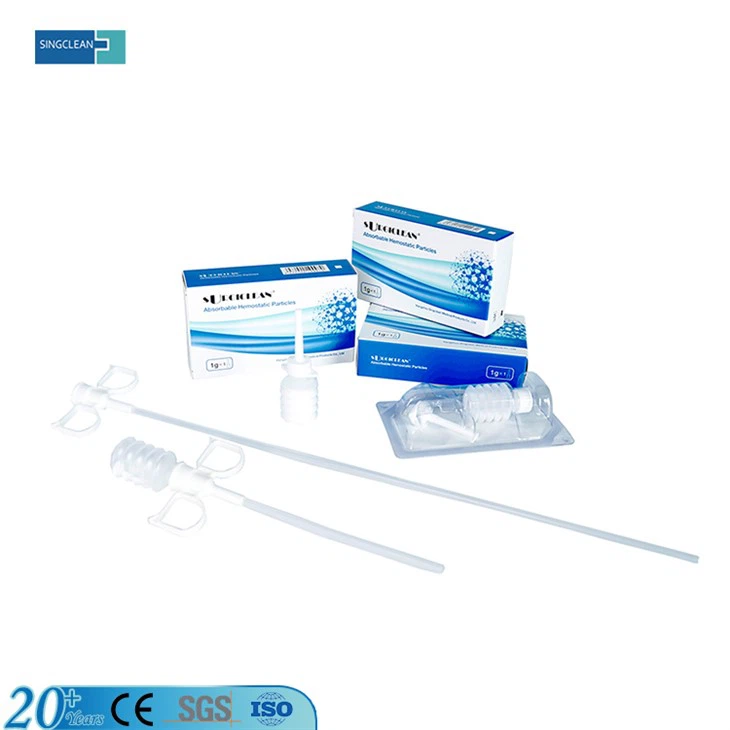
If you are interested in learning more about our powder absorbable hemostats or are considering purchasing them for your medical facility, we encourage you to contact us for a detailed discussion. Our team of experts is available to provide you with more information on the product's features, applications, and suitability for different patient populations. We look forward to the opportunity to work with you and contribute to better hemostasis management in your practice.
References
- Hoffman M, Monroe DM 3rd. A cell - based model of hemostasis. Thromb Haemost. 2001;85(6):958 - 965.
- Lillicrap D. Hemophilia: a disorder of coagulation factor synthesis. Semin Thromb Hemost. 2009;35(6):607 - 614.
- Tripodi A, Chantarangkul V, Mannucci PM. The coagulopathy of liver disease. N Engl J Med. 2015;373(22):2174 - 2184.