


Absorbable hemostatics are crucial medical products that have revolutionized the field of hemostasis management. As a supplier of absorbable hemostatic products, I have witnessed firsthand the significant impact these materials can have on patient outcomes. However, one of the most important considerations in the use of absorbable hemostatics is their interaction with other medications. Understanding these interactions is essential for ensuring the safety and efficacy of medical treatments.
Mechanisms of Absorbable Hemostatics
Before delving into the interactions with other medications, it's important to understand how absorbable hemostatics work. Absorbable hemostatic agents can be classified into several types, including natural and synthetic materials. Natural materials such as collagen, gelatin, and fibrin are derived from biological sources and are well - tolerated by the human body. Synthetic materials, on the other hand, are designed to mimic the properties of natural hemostatic agents and offer unique advantages in terms of consistency and performance.
The primary mechanism of action of absorbable hemostatics is to promote the formation of a blood clot. They do this by providing a scaffold for platelet adhesion and aggregation, and by activating the coagulation cascade. For example, collagen - based hemostatics expose platelets to collagen fibers, which triggers platelet activation and the release of clotting factors. Gelatin - based products swell in the presence of blood, creating a physical barrier that helps to stop bleeding and also promotes platelet adhesion.
Interactions with Anticoagulants
Anticoagulants are medications used to prevent the formation of blood clots. They are commonly prescribed to patients at risk of stroke, deep vein thrombosis, and pulmonary embolism. The most widely used anticoagulants include heparin, warfarin, and direct oral anticoagulants (DOACs) such as apixaban, rivaroxaban, and dabigatran.
When absorbable hemostatics are used in patients taking anticoagulants, there is a potential for reduced efficacy. Anticoagulants work by inhibiting various steps in the coagulation cascade. For instance, heparin binds to antithrombin III, enhancing its ability to inactivate thrombin and factor Xa. Warfarin inhibits the synthesis of vitamin K - dependent clotting factors. DOACs directly target specific clotting factors, such as factor Xa or thrombin.
In the presence of anticoagulants, the normal clot - forming process is disrupted. Absorbable hemostatics may have difficulty initiating and maintaining the clotting process because the key clotting factors are either inhibited or their synthesis is impaired. However, some absorbable hemostatics may still be effective to a certain extent. For example, collagen - based hemostatics can directly activate platelets, which may overcome the anticoagulant effect to some degree.
In clinical practice, it is important to assess the patient's anticoagulation status before using absorbable hemostatics. If possible, the anticoagulant therapy may need to be adjusted or temporarily discontinued under the guidance of a healthcare provider. This decision should be based on a careful balance between the risk of bleeding and the risk of thrombosis.
Interactions with Antiplatelet Agents
Antiplatelet agents are medications that prevent platelets from clumping together and forming blood clots. They are commonly used in patients with cardiovascular diseases, such as coronary artery disease and stroke prevention. The most commonly used antiplatelet agents include aspirin, clopidogrel, and ticagrelor.
Aspirin inhibits the cyclooxygenase (COX) enzyme, which is involved in the synthesis of thromboxane A2, a potent platelet aggregator. Clopidogrel and ticagrelor block the P2Y12 receptor on platelets, preventing the activation of platelets by adenosine diphosphate (ADP).
Similar to anticoagulants, antiplatelet agents can interfere with the action of absorbable hemostatics. Since many absorbable hemostatics rely on platelet adhesion and aggregation to form a clot, the presence of antiplatelet agents can reduce their effectiveness. Platelets are less likely to adhere to the surface of the hemostatic material and form a stable clot.
In cases where patients are taking antiplatelet agents, the use of absorbable hemostatics may need to be combined with other hemostatic strategies. For example, in addition to using an absorbable hemostatic, local pressure or the use of a higher - dose hemostatic product may be required.
Interactions with Antibiotics
Antibiotics are medications used to treat bacterial infections. There is limited evidence regarding the direct interaction between absorbable hemostatics and antibiotics. However, some antibiotics may have an impact on the body's immune response and wound healing, which indirectly affects the performance of absorbable hemostatics.
For example, certain broad - spectrum antibiotics can disrupt the normal flora of the body, which may increase the risk of infection at the site of hemostasis. Infected wounds can have a negative impact on the clotting process and the absorption of the hemostatic material. Additionally, some antibiotics may have side effects that affect the blood's coagulation properties.
It is important to ensure that the use of antibiotics is appropriate and does not interfere with the hemostatic process. In some cases, the choice of antibiotic may need to be adjusted based on the patient's hemostasis requirements.
Product - Specific Considerations
As a supplier of absorbable hemostatics, we offer a range of products, including Hemostatic Powder, Haemostatic Powder, and Wound Clotting Powder. Each of these products has unique properties and may interact differently with other medications.
Our powder - based absorbable hemostatics are designed to be highly effective in promoting rapid clot formation. They are easy to apply and can be used in a variety of surgical and non - surgical settings. However, when considering their use in patients taking other medications, it is important to consult the product's prescribing information and seek professional medical advice.
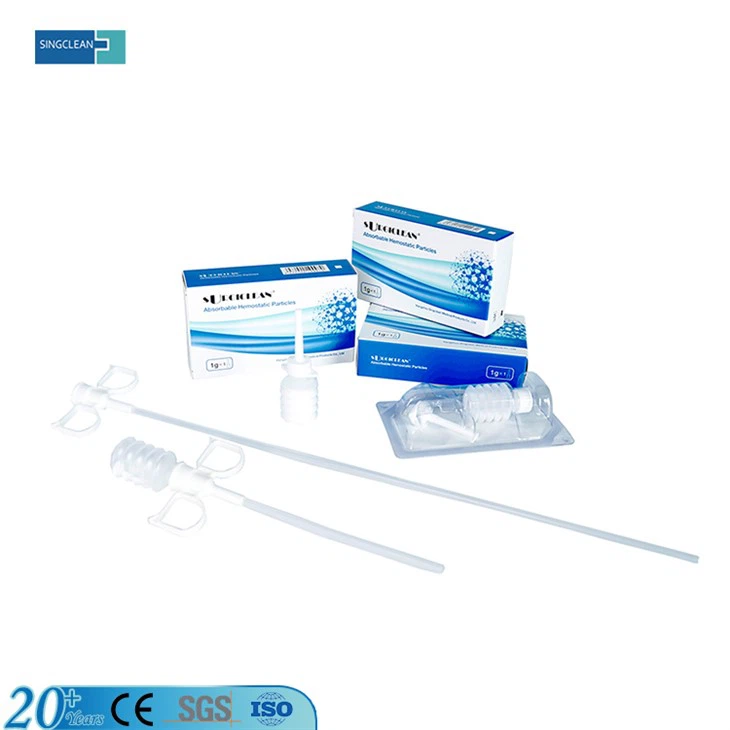

Why Powder Absorbable Hemostats Are Becoming the Preferred Choice in Modern Surgery
In modern surgical practice, surgeons increasingly prefer powder absorbable hemostats because they provide rapid bleeding control while remaining easy to apply in complex operative fields. Unlike traditional gauze, sutures, or electrocautery, absorbable hemostatic powders can cover irregular wound surfaces quickly and reach areas that are difficult to access during minimally invasive procedures.
The demand for topical absorbable hemostats has grown significantly in recent years due to several clinical trends:
Increasing numbers of minimally invasive and laparoscopic surgeries
More elderly patients receiving anticoagulant or antiplatelet therapy
Greater emphasis on reducing operative time
Enhanced recovery after surgery (ERAS) protocols
Growing need to minimize intraoperative blood loss
Plant-derived absorbable hemostatic powders are particularly attractive because they contain no human or animal-derived components, reducing concerns regarding immunogenicity or disease transmission while maintaining excellent biocompatibility.
As an advanced absorbable hemostatic agent, Surgiclean® provides surgeons with a ready-to-use solution that combines rapid fluid absorption, reliable clot formation, and complete biodegradation.
Conclusion and Call to Action
In conclusion, the interaction between absorbable hemostatics and other medications is a complex issue that requires careful consideration. Healthcare providers need to be aware of the potential interactions when using absorbable hemostatics in patients taking anticoagulants, antiplatelet agents, and antibiotics. By understanding these interactions, they can make informed decisions to ensure the safety and efficacy of hemostatic treatment.
As a supplier of high - quality absorbable hemostatic products, we are committed to providing the latest information and support to our customers. If you are interested in learning more about our products or have questions regarding their use in combination with other medications, we encourage you to contact us for a detailed discussion. We are eager to engage in procurement discussions and help you find the best hemostatic solutions for your specific needs.
FAQ
Q: What is a powder absorbable hemostat?
A: A powder absorbable hemostat is a sterile topical medical device that rapidly absorbs plasma, concentrates platelets and clotting factors, and promotes natural clot formation. After hemostasis, the material is gradually absorbed by the body.
Q: How long does an absorbable hemostatic powder remain in the body?
A: Depending on the formulation, most plant-based absorbable hemostatic powders are fully biodegraded within approximately two weeks. Surgiclean® is metabolized into glucose derivatives and ultimately eliminated through normal metabolic pathways.
Q: Can absorbable hemostatic powder be used during laparoscopic surgery?
A: Yes. Modern absorbable hemostatic powders are widely used in minimally invasive procedures through dedicated applicators, allowing precise delivery to difficult-to-reach bleeding sites.
Q: Is plant-based hemostatic powder safe?
A: Plant-derived hemostatic powders have demonstrated excellent safety and biocompatibility in numerous clinical studies. Since they contain no human or animal-derived components, they minimize the risk of immune reactions and disease transmission.
Q: Does Surgiclean® support OEM and private labeling?
A: Yes. Surgiclean® provides comprehensive OEM and ODM manufacturing services for global medical device distributors, including customized packaging, branding, regulatory documentation, and international registration support.
References
Hirsh J, Guyatt G, Albers GW, et al. Antithrombotic and thrombolytic therapy: American College of Chest Physicians Evidence - Based Clinical Practice Guidelines (8th Edition). Chest. 2008;133(6 Suppl):110S - 112S.
Wiviott SD, Braunwald E, McCabe CH, et al. Ticagrelor versus Clopidogrel in Patients with Acute Coronary Syndromes. N Engl J Med. 2009;361(11):1045 - 1057.
Poller L, Hirsh J, Raschke R, et al. The practical management of patients receiving vitamin K antagonists: the Seventh ACCP Conference on Antithrombotic and Thrombolytic Therapy. Chest. 2004;126(3 Suppl):204S - 233S.