


Blood clotting sponges, also known as hemostatic sponges, are a critical tool in modern medicine, particularly in surgical procedures and wound management. As a supplier of high - quality blood clotting sponges, I am often asked about how these sponges interact with anticoagulants. This topic is not only of great interest to medical professionals but also has significant implications for patient care.
Understanding Blood Clotting Sponges
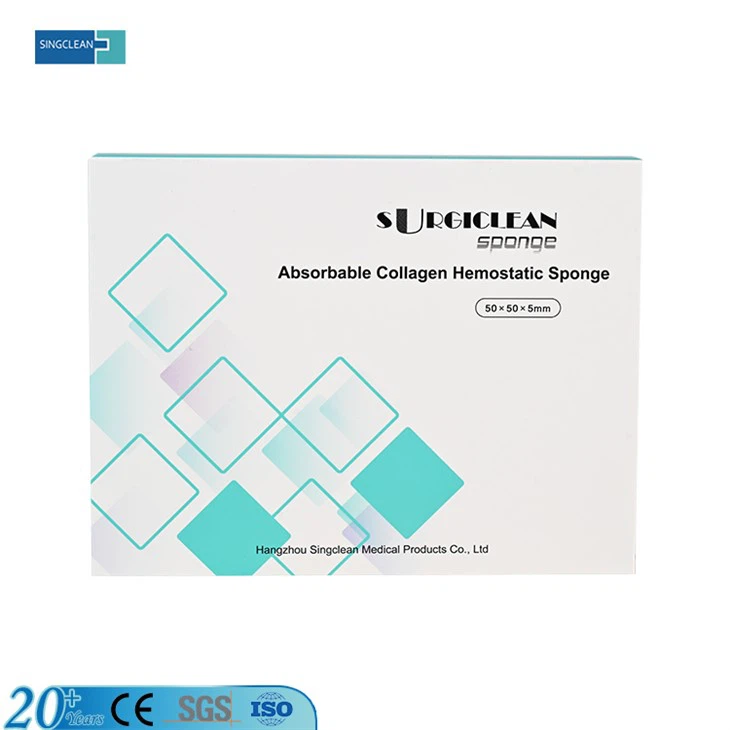
Blood clotting sponges are designed to promote hemostasis, the process of stopping bleeding. There are different types of blood clotting sponges available in the market, such as Sponge Hemostatic, Absorbable Hemostatic Sponge, and Collagen Hemostat. These sponges work through various mechanisms.
Some sponges are made of materials that can physically absorb blood, concentrating clotting factors and platelets at the site of bleeding. For example, collagen - based sponges mimic the extracellular matrix in the body. Collagen is a natural substance that activates platelets, which are an essential component of the blood - clotting cascade. When a collagen hemostat is placed on a bleeding wound, platelets adhere to the collagen surface, become activated, and start to form a platelet plug. This initial plug serves as a scaffold for the subsequent formation of a fibrin clot.
Another type of blood - clotting sponge may contain agents that directly activate the clotting cascade. These agents can trigger a series of enzymatic reactions that lead to the conversion of fibrinogen to fibrin, the protein that forms the meshwork of a blood clot.
Anticoagulants: Their Role and Mechanisms
Anticoagulants, on the other hand, are medications used to prevent blood clots from forming. They are commonly prescribed to patients at risk of thromboembolic events, such as those with atrial fibrillation, deep vein thrombosis, or after certain surgical procedures. There are several classes of anticoagulants, each with its own mechanism of action.
Heparin is one of the most well - known anticoagulants. It works by enhancing the activity of antithrombin III, a natural protein in the blood that inhibits several clotting factors, including thrombin and factor Xa. By increasing the activity of antithrombin III, heparin can rapidly reduce the ability of the blood to clot.
Warfarin is an oral anticoagulant that acts by inhibiting the synthesis of vitamin K - dependent clotting factors in the liver. Vitamin K is necessary for the activation of factors II, VII, IX, and X. By interfering with vitamin K metabolism, warfarin can slow down the clotting process over a longer period.
Newer anticoagulants, such as direct oral anticoagulants (DOACs), directly target specific clotting factors. For example, rivaroxaban is a direct factor Xa inhibitor, and dabigatran is a direct thrombin inhibitor. These medications have a more predictable anticoagulant effect and fewer drug - drug interactions compared to traditional anticoagulants.
Interaction between Blood Clotting Sponges and Anticoagulants
The interaction between blood clotting sponges and anticoagulants is complex and depends on several factors, including the type of sponge, the type of anticoagulant, and the patient's individual physiological state.

When a patient is on anticoagulant therapy, the normal blood - clotting process is impaired. This means that the effectiveness of blood clotting sponges may be reduced. For example, in a patient taking heparin, the enhanced antithrombin III activity can prevent the formation of thrombin, which is essential for the conversion of fibrinogen to fibrin. As a result, a collagen - based sponge that relies on platelet activation and subsequent fibrin formation may have a diminished ability to promote hemostasis.
However, some blood clotting sponges may still be effective even in the presence of anticoagulants. Certain sponges have a strong physical absorption capacity. They can absorb a large volume of blood, which can help to localize clotting factors and platelets at the wound site. This physical concentration effect may overcome, to some extent, the anticoagulant effect in the surrounding blood.

In addition, the type of anticoagulant also matters. Warfarin - treated patients have a more long - term and systemic impairment of clotting factor synthesis. In contrast, patients on DOACs may have a more targeted and reversible anticoagulant effect. This difference can influence how well blood clotting sponges work. For example, a sponge that can directly activate the clotting cascade may be more effective in a patient on a DOAC than in a patient on warfarin, as the DOAC's effect is more specific and may be more easily counteracted at the local level.
Clinical Implications
The interaction between blood clotting sponges and anticoagulants has significant clinical implications. In surgical settings, patients on anticoagulant therapy are at a higher risk of excessive bleeding. Surgeons need to carefully consider the use of blood clotting sponges and the type of sponge to be used.
If a patient is on a short - acting anticoagulant, such as heparin, it may be possible to time the surgery so that the anticoagulant effect has worn off before using the blood clotting sponge. However, this is not always feasible, especially in emergency situations. In such cases, a more potent blood - clotting sponge, such as one with a high concentration of clot - activating agents, may be required.
In wound management, patients on anticoagulants may have difficulty achieving hemostasis at the wound site. The use of a blood clotting sponge can be a valuable adjunct to other wound - care measures. However, healthcare providers need to be aware of the potential limitations of the sponge due to the patient's anticoagulant status.
Research and Development
Given the importance of this interaction, there is ongoing research in this area. Scientists are working on developing new blood clotting sponges that are more effective in the presence of anticoagulants. One approach is to modify the composition of the sponges to make them more resistant to the effects of anticoagulants. For example, some researchers are exploring the use of bioactive agents in the sponges that can directly counteract the action of specific anticoagulants.
Another area of research is to better understand the pharmacokinetics and pharmacodynamics of anticoagulants in the context of blood - clotting sponge use. This knowledge can help healthcare providers make more informed decisions about when and how to use blood clotting sponges in patients on anticoagulant therapy.
Conclusion
In conclusion, the interaction between blood clotting sponges and anticoagulants is a complex and important topic in medicine. As a supplier of blood clotting sponges, I am committed to providing products that can effectively promote hemostasis, even in challenging situations such as patients on anticoagulant therapy. Our Sponge Hemostatic, Absorbable Hemostatic Sponge, and Collagen Hemostat are designed with the latest scientific knowledge to offer the best possible performance.
If you are a medical professional or involved in the procurement of medical supplies, and you are interested in learning more about our blood clotting sponges and how they can be used in patients on anticoagulant therapy, we encourage you to reach out for further discussions and potential procurement. We are here to provide you with the information and support you need to make the right decisions for your patients and your practice.
References
- Hoffman M, Monroe DM. A cell - based model of hemostasis. Thromb Haemost. 2001;85(6):958 - 965.
- Hirsh J, Guyatt G, Albers GW, et al. Evidence - based anticoagulant therapy, 9th ed: American College of Chest Physicians Evidence - Based Clinical Practice Guidelines. Chest. 2012;141(2 Suppl):e152S - e184S.
- Weitz JI, Hirsh J. Low - molecular - weight heparins. N Engl J Med. 2001;344(17):1309 - 1317.
- Ansell J, Hirsh J, Hylek E, et al. Pharmacology and management of the vitamin K antagonists: American College of Chest Physicians Evidence - Based Clinical Practice Guidelines (8th Edition). Chest. 2008;133(6 Suppl):160S - 198S.