


Hemostatic gauze pads are a crucial tool in the medical field, especially when it comes to controlling bleeding. As a supplier of high - quality hemostatic gauze pads, I've had the opportunity to delve deep into the science behind their hemostatic function. In this blog, I'll explore the principles that make these pads so effective in stopping bleeding.
The Basics of Hemostasis
Before we dive into the specific mechanisms of hemostatic gauze pads, it's essential to understand the natural process of hemostasis. Hemostasis is the body's way of stopping bleeding from damaged blood vessels. It involves three main stages: vascular spasm, platelet plug formation, and blood coagulation.

Vascular spasm is the immediate response of the blood vessel to injury. The smooth muscles in the vessel wall contract, narrowing the vessel and reducing blood flow. Platelet plug formation occurs when platelets in the blood adhere to the damaged vessel wall and each other, forming a temporary plug to seal the wound. Blood coagulation is the final stage, where a series of enzymatic reactions lead to the formation of a fibrin clot, which reinforces the platelet plug and stops the bleeding.
How Hemostatic Gauze Pads Assist in Hemostasis
Physical Mechanisms
One of the primary ways hemostatic gauze pads work is through physical means. When applied to a bleeding wound, the gauze provides a surface for platelets to adhere to. The rough texture of the gauze mimics the damaged vessel wall, which activates platelets. Platelets then start to change shape, become sticky, and aggregate on the surface of the gauze, initiating the formation of a platelet plug.
Moreover, the gauze can absorb blood, concentrating the platelets and clotting factors at the wound site. This concentration effect enhances the efficiency of the clotting process. The absorption also helps to remove excess fluid from the wound, which can otherwise wash away the forming clot.
Chemical Mechanisms
Many hemostatic gauze pads are impregnated with substances that promote blood clotting. These substances can interact with the body's clotting cascade, a complex series of reactions involving various proteins and enzymes.
Some gauze pads contain calcium salts. Calcium ions are essential for several steps in the clotting cascade. They help in the activation of clotting factors, such as factor X and prothrombin, which are crucial for the formation of fibrin. By providing an additional source of calcium ions, the gauze can accelerate the clotting process.
Another common additive is thrombin. Thrombin is an enzyme that plays a central role in blood coagulation. It converts fibrinogen, a soluble protein in the blood, into fibrin, an insoluble protein that forms the meshwork of the blood clot. When thrombin - impregnated gauze is applied to a wound, it directly promotes the formation of fibrin, leading to faster clotting.
Biological Mechanisms
In addition to physical and chemical mechanisms, some hemostatic gauze pads are designed to interact with the body's biological processes in a more sophisticated way. For example, some gauze pads are made from materials that can release growth factors or cytokines. These substances can attract immune cells and fibroblasts to the wound site. Immune cells help to clean the wound and prevent infection, while fibroblasts are involved in the repair and regeneration of the damaged tissue. By promoting wound healing, these gauze pads indirectly contribute to hemostasis.
Types of Hemostatic Gauze Pads and Their Mechanisms
Hemostatic Gauze
Hemostatic gauze is a widely used type of hemostatic product. It is typically made from natural or synthetic fibers and may be impregnated with various hemostatic agents. Natural fiber gauze, such as cotton gauze, is biocompatible and has good absorbency. Synthetic fiber gauze, on the other hand, can be engineered to have specific properties, such as improved strength and stability.
The hemostatic agents in hemostatic gauze can vary. Some gauze is impregnated with kaolin, a clay mineral that activates the intrinsic pathway of the clotting cascade. Kaolin provides a negatively charged surface that activates factor XII, which then sets off a series of reactions leading to the formation of a clot.
Blood Stop Gauze
Blood stop gauze is designed specifically to stop bleeding quickly. It often contains a combination of physical and chemical hemostatic mechanisms. For example, it may have a high - absorbency core to concentrate the blood and clotting factors, along with a coating of hemostatic agents.
Some blood stop gauze is treated with chitosan, a natural polymer derived from crustacean shells. Chitosan has several hemostatic properties. It can interact with red blood cells and platelets, causing them to aggregate. It also has antibacterial properties, which can help prevent wound infection during the hemostasis process.
Absorbable Hemostat
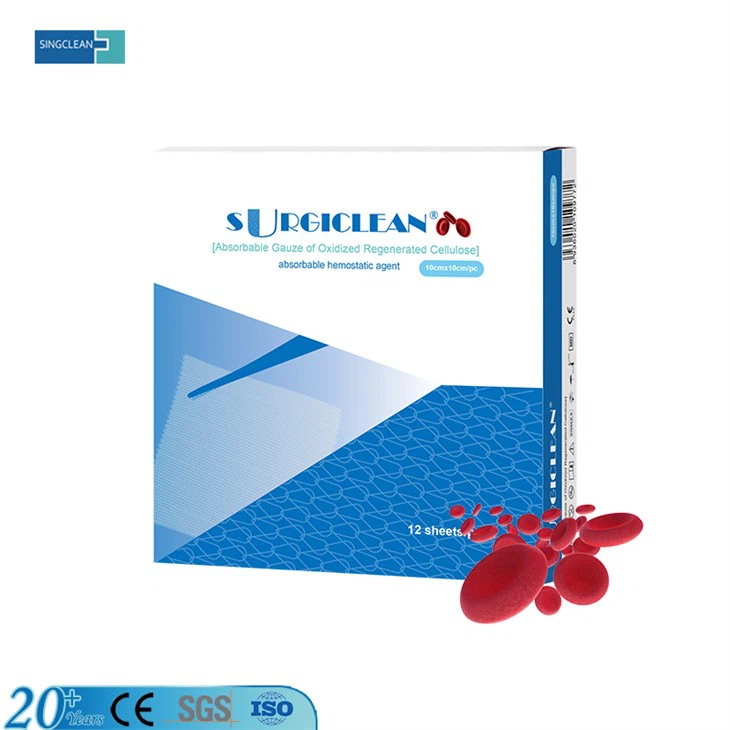
Absorbable hemostats are a special type of hemostatic gauze pad that can be absorbed by the body over time. This is particularly useful in surgical procedures, where the gauze can be left in the wound without the need for removal.
Absorbable hemostats are usually made from materials such as oxidized regenerated cellulose (ORC) or gelatin. ORC works by providing a scaffold for platelet adhesion and activation. It also has an acidic pH, which can help to activate the clotting cascade. Gelatin - based absorbable hemostats can swell in the presence of blood, creating a physical barrier to stop bleeding. They also release gelatin peptides that can interact with clotting factors and promote clot formation.
Advantages of Using Hemostatic Gauze Pads
The use of hemostatic gauze pads offers several advantages in the medical field. Firstly, they can significantly reduce the time required to achieve hemostasis. This is especially important in emergency situations, where rapid bleeding control can save lives.
Secondly, hemostatic gauze pads are easy to use. They can be quickly applied to a wound by medical professionals or even by non - medical personnel in some cases. This simplicity makes them a valuable tool in first - aid kits and battlefield medicine.
Thirdly, these pads can help to reduce blood loss. By promoting clotting, they minimize the amount of blood that is lost from the body, which can prevent complications such as anemia and hypovolemic shock.
Contact for Procurement
If you're interested in learning more about our high - quality hemostatic gauze pads or are looking to place an order, we'd love to hear from you. Our products are designed with the latest scientific knowledge and manufacturing techniques to ensure optimal hemostatic performance. Whether you're a hospital, a clinic, or a distributor, we can provide you with the right hemostatic solutions for your needs. Reach out to us to start a procurement discussion and find out how our hemostatic gauze pads can benefit your organization.
References
- Hoffman, M., & Monroe, D. M. (2001). A cell - based model of hemostasis. Thrombosis and Haemostasis, 85(6), 958 - 965.
- Reddy, V., & DiPietro, L. A. (2012). Inflammation in wound repair: molecular and cellular mechanisms. Journal of Investigative Dermatology, 132(3), 564 - 575.
- Weitz, J. I., & Crowther, M. A. (2016). New anticoagulants. New England Journal of Medicine, 374(1), 113 - 124.