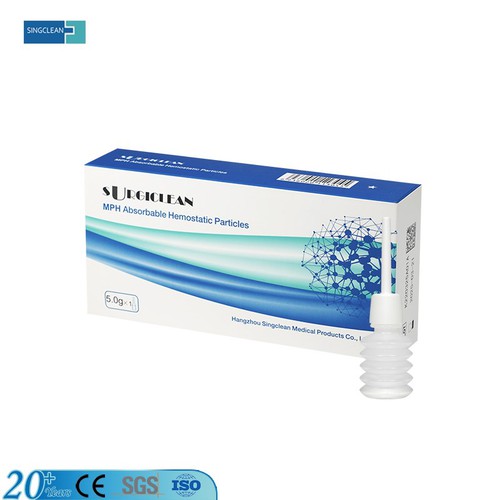
As a supplier of absorbable hemostatic powder, one question I hear frequently is: "Does it really work for venous bleeding?"
It's a fair question. Venous bleeding is different from arterial bleeding – it doesn't spurt under high pressure, but it flows steadily and can be difficult to control, especially on irregular wound surfaces or during surgery.
In this article, we'll explain what venous bleeding is, how absorbable hemostatic powder works to stop it, and why products like Surgiclean® MPH Absorbable Hemostatic Particles are clinically effective – without relying on misleading science.
What Is Venous Bleeding?
Venous bleeding occurs when a vein is damaged. Veins carry deoxygenated blood back to the heart under relatively low pressure. When cut or punctured, blood flows out in a steady, continuous stream – unlike the pulsating, high-pressure spurt of arterial bleeding.
While less dramatic than arterial bleeding, venous bleeding can still be dangerous, especially in surgery or deep trauma. It doesn't stop easily with pressure alone, and it often oozes from rough surfaces, soft tissues, or difficult-to-reach areas.

How Does Absorbable Hemostatic Powder Work?
Let's be clear about the science – because there's a lot of misinformation out there.
Our Surgiclean® MPH Absorbable Hemostatic Powder is 100% plant-based (derived from potato starch) and contains no thrombin, no animal proteins, and no chemical clotting activators.
So how does it stop bleeding?
Step 1: Rapid Fluid Absorption
The powder features a unique space-net microstructure (particle diameter: 30.8–97 μm). Upon contact with blood, it immediately absorbs water from plasma – like a molecular sponge.
Step 2: Concentration of Clotting Components
By removing water, the powder concentrates platelets, red blood cells, and coagulation factors at the bleeding site. This dramatically increases the local density of everything needed to form a clot.
Step 3: Physical Scaffold & Gel Formation
The powder particles swell and form a gel-like physical barrier that seals the wound, provides a scaffold for clot attachment, and prevents re-bleeding.
Step 4: Indirect Acceleration of Coagulation
Because coagulation factors are now highly concentrated, the body's endogenous coagulation cascade proceeds faster – not because the powder chemically activates it, but because the reactants are no longer diluted by excess fluid.
Result: A stable clot forms typically within 1 minute, with clot strength 2–3 times higher than a physiological clot.
Does It Specifically Work for Venous Bleeding?
Yes – and here's why venous bleeding is actually an ideal use case for absorbable hemostatic powder.
| Feature of Venous Bleeding | Why Hemostatic Powder Works Well |
|---|---|
| Low-pressure, continuous flow | Powder can be applied directly and stays in place |
| Oozing from rough or irregular surfaces | Powder conforms to any shape, reaches crevices |
| Difficult to control with gauze alone | Powder creates immediate physical barrier |
| Common in soft tissue, liver, spleen, thyroid surgery | Powder is indicated for these exact scenarios |
According to Surgiclean® product documentation, the powder is specifically indicated for capillary, venous, and arteriolar bleeding – making venous bleeding a primary target application.
"Surgiclean® is indicated in surgery as an adjunctive hemostatic device to assist when control of capillary, venous, and arteriolar bleeding by pressure, ligature, and other conventional procedures is ineffective or impractical."
Clinical Advantages for Venous Bleeding Control
When using Surgiclean® absorbable hemostatic powder for venous bleeding, here's what you can expect:
Fast acting – Hemostasis typically achieved within 1 minute
High success rate – 3-minute hemostasis success rate higher than many alternatives
Effective on wet surfaces – Unlike some products that wash away
No mixing or refrigeration – Ready to use, straight from the package
Safe for all patients – Works regardless of coagulation status
Fully absorbable – Degrades into water and CO₂ within 14 days
Real-World Evidence
Over 810,000 pieces of Surgiclean® hemostatic powder have been used clinically – with no reported adverse events.
Surgeons have reported successful venous bleeding control in:
Hepatobiliary surgery – liver laceration, splenectomy fossa
Cardiothoracic surgery – vascular anastomosis, lung stump
Spine and joint surgery – bone surface bleeding, soft tissue oozing
Thyroid and breast surgery – reducing postoperative drainage
Minimally invasive surgery – laparoscopic applications using TQ-3/TQ-4 applicators
How to Use Absorbable Hemostatic Powder for Venous Bleeding
For optimal results, follow these steps:
Remove excess blood from the wound surface using gauze
Apply powder directly – fully cover the bleeding area
Press with dry gauze for 2–3 minutes
Irrigate excess powder once bleeding stops
Common mistake: Removing the gauze too early or pulling dry gauze off a fresh clot can cause re-bleeding. Always soak the gauze with saline first if needed.
Safety & Certifications
Surgiclean® MPH is not just effective – it's medically certified:
CE2460
NMPA (China)
ISO13485
MDSAP
BGMP / KGMP
It is EO sterilized, non-pyrogenic, and contains no harmful chemicals or animal products.
Conclusion: A Reliable Solution for Venous Bleeding
To summarize:
Venous bleeding is a steady, low-pressure flow from damaged veins – common in surgery and trauma.
Absorbable hemostatic powder works through physical mechanisms (water absorption, concentration of clotting factors, scaffold formation), not by chemically activating platelets or clotting factors.
Surgiclean® MPH is clinically proven for venous bleeding, with over 810,000 units used safely, and hemostasis achieved normally within 1 minute.
Whether you're a surgeon, a hospital procurement specialist, or a medical distributor, Surgiclean® Absorbable Hemostatic Powder offers a safe, effective, and easy-to-use solution for venous bleeding control.