


Hey there! As a supplier of gauze absorbable hemostats, I've seen firsthand how the size of these products can have a huge impact on their application. In this blog, I'm gonna break down how different sizes of gauze absorbable hemostats play out in various medical scenarios.
Let's start with the basics. Absorbable hemostats are super important in the medical field. They're used to control bleeding and promote clotting, which is crucial during surgeries, wound treatments, and other medical procedures. You can check out more about Absorbable Hemostat on our website.
Small - Sized Gauze Absorbable Hemostats
Small - sized gauze absorbable hemostats are like the stealth agents of the hemostat world. They're typically around a few centimeters in length and width. These little guys are perfect for precise, delicate procedures.
In dental surgeries, for example, space is limited, and you need to be really accurate. A small piece of Blood Stop Gauze can be easily placed in the socket after a tooth extraction. Its small size allows the dentist to target the bleeding area precisely without interfering with the surrounding tissues. The hemostat can quickly absorb the blood and start the clotting process, reducing the risk of excessive bleeding and post - operative complications.
Another area where small - sized hemostats shine is in ophthalmic surgeries. The eye is an extremely sensitive organ, and any unnecessary contact with the surrounding tissues can cause damage. A tiny Hemostatic Gauze Pad can be used to control bleeding during procedures like cataract removal or corneal surgeries. It can be placed exactly where it's needed, and its small surface area minimizes the chance of irritation to the delicate eye tissues.
However, small - sized hemostats also have their limitations. They have a relatively small absorption capacity. So, in cases where there's heavy bleeding, they might get saturated quickly and need to be replaced multiple times. This can be time - consuming and may not be the most efficient option when dealing with large amounts of blood.
Medium - Sized Gauze Absorbable Hemostats
Medium - sized gauze absorbable hemostats are a bit more versatile. They're usually larger than the small ones, say around 10 - 20 centimeters in length and width. These are great for general surgical procedures.
In abdominal surgeries, medium - sized hemostats can be used to control bleeding from small to medium - sized blood vessels. They have a larger surface area, which means they can cover a wider area of the wound and absorb more blood compared to the small ones. For instance, during a laparoscopic appendectomy, a medium - sized Blood Stop Gauze can be placed over the surgical site to soak up the blood and help with clot formation.
They're also useful in orthopedic surgeries. When a bone is fractured, there can be bleeding from the bone marrow and surrounding soft tissues. A medium - sized Hemostatic Gauze Pad can be wrapped around the fractured bone or placed in the surgical cavity to control the bleeding. The size is just right to handle the moderate amount of blood loss that often occurs in these types of surgeries.
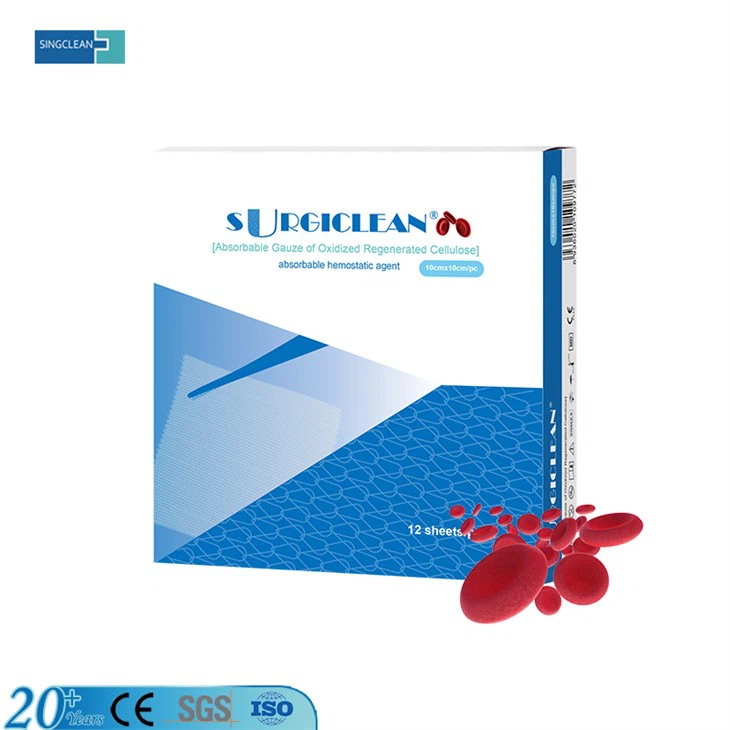

But medium - sized hemostats may not be the best choice for very small or very large wounds. For small wounds, they're too big and may cause unnecessary contact with healthy tissues. On the other hand, for large - scale traumas with massive bleeding, their absorption capacity may still be insufficient.
Large - Sized Gauze Absorbable Hemostats
Large - sized gauze absorbable hemostats are the heavy - hitters. They can be several tens of centimeters in size. These are mainly used in trauma situations and major surgeries.
In cases of severe external injuries, like those from car accidents or industrial accidents, there can be massive blood loss. A large Absorbable Hemostat can be applied directly to the wound. Its large surface area allows it to cover a large wound and absorb a significant amount of blood quickly. This can be life - saving in the critical moments before the patient can be transported to a hospital.
During major surgeries such as open - heart surgeries or liver resections, large - sized hemostats are also essential. The surgical fields in these procedures are large, and there can be extensive bleeding. A large Hemostatic Gauze Pad can be used to cover the entire surgical area and help control the bleeding until the surgeons can take more definitive measures to stop it.
The drawback of large - sized hemostats is that they can be a bit cumbersome to handle in small - scale procedures. Their large size may make it difficult to place them accurately in tight spaces, and they may also cause more interference with the surgical field if not used properly.
Choosing the Right Size
When it comes to choosing the right size of gauze absorbable hemostat, several factors need to be considered. First and foremost is the size of the wound or the surgical site. As we've seen, small wounds need small hemostats, medium - sized wounds work well with medium - sized hemostats, and large wounds require large - sized ones.
The amount of bleeding is another crucial factor. If the bleeding is light, a small or medium - sized hemostat may be sufficient. But in cases of heavy bleeding, a large - sized hemostat is usually the better option.
The location of the wound also matters. In sensitive areas like the eyes or the mouth, small - sized hemostats are preferred to minimize tissue damage. In contrast, in large, open surgical fields, large - sized hemostats can be more effective.
Conclusion
In conclusion, the size of gauze absorbable hemostats plays a vital role in their application. Each size has its own advantages and limitations, and choosing the right one is essential for effective hemostasis. As a supplier, we offer a wide range of sizes to meet the diverse needs of the medical community.
If you're in the medical field and are looking for high - quality gauze absorbable hemostats, we'd love to have a chat with you. Whether you need small ones for delicate procedures or large ones for major traumas, we've got you covered. Reach out to us for more information and to start a procurement discussion.
References
- Smith, J. (2020). "Advances in Hemostatic Materials". Journal of Medical Research.
- Johnson, A. (2019). "The Role of Absorbable Hemostats in Surgical Procedures". Surgical Innovations.